State of the City’s Housing Stock
In the first half of 2022, there was a significant spike in new building permits for residential units as developers hurried to take advantage of the state’s 421-a tax exemption before its expiration in June 2022. This rush, along with the failure to enact a replacement for the tax exemption, led to a dramatic decrease in new permits in 2023, dropping to the lowest level seen since 2016. Although permits are an indicator of future development, the actual number of residential units completed in 2023 rose from the previous year and stayed high compared to historical averages. Notably, the period from 2021 to 2023 saw the highest volume of housing completions since 2010 for any three-year span. However, the outlook for the coming years remains uncertain. In 2015 a previous 421-a expiration resulted in an elevated count of residential completions in the following years. While a comparable pattern might emerge following the 2022 spike in new permits, evolving economic factors like increasing interest rates and an impending completion deadline add uncertainty as to whether all the projects grandfathered under 421a would move forward. In April 2024, the state extended the completion deadline for projects initiated before June 2022 raising the possibility that the 2022 permit surge could still lead to a spike in completions in 2024 and 2025. In addition the state now also has a new version of the tax exemption program, named 485-x, thus making possible a prolonged period of elevated completion rates, depending on its takeup rate.
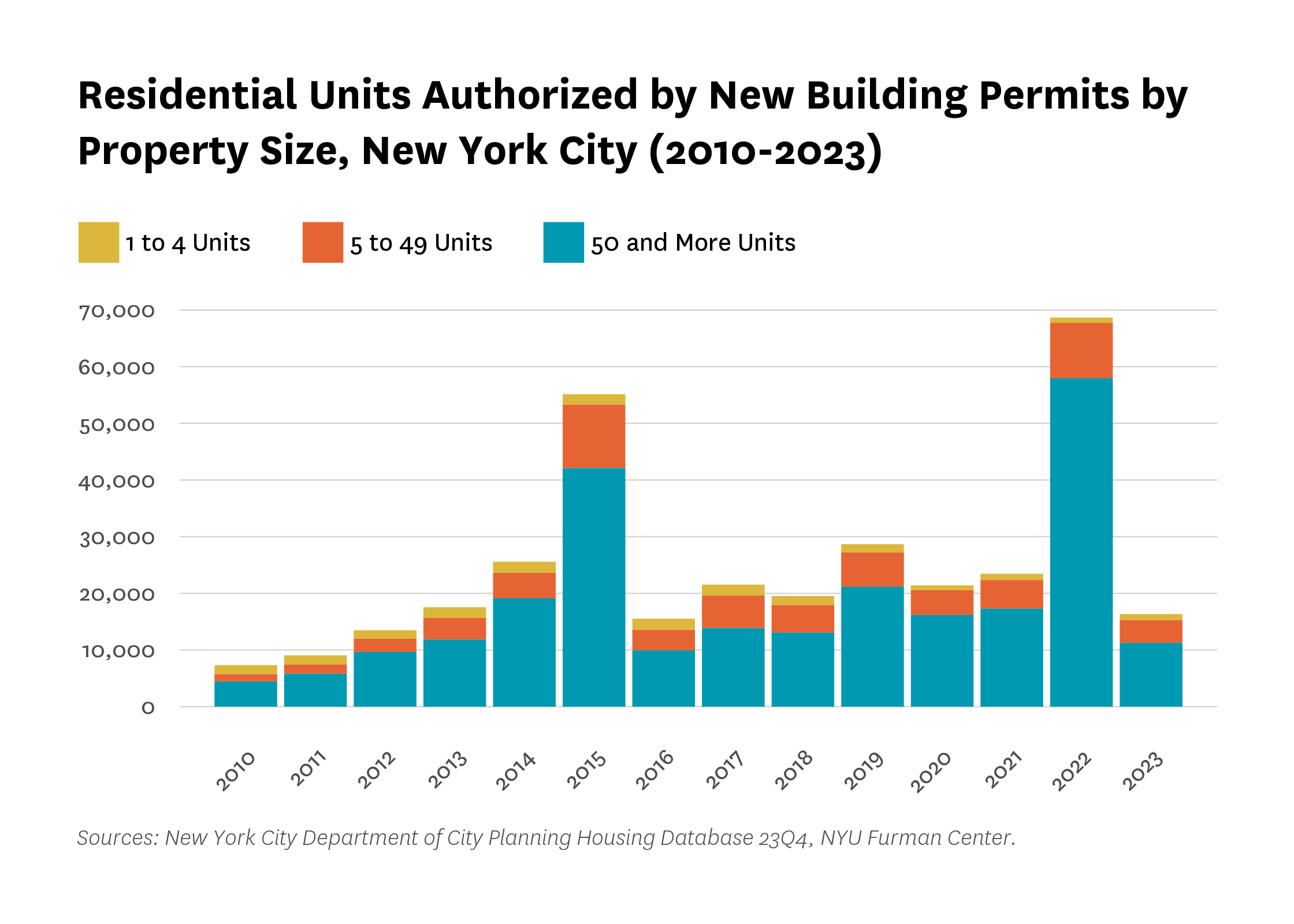
In 2023, the number of residential units authorized by new building permits fell to its lowest level since 2016, after a historic spike in 2022.
The number of housing units authorized by new building permits in New York City dropped sharply to 16,348 in 2023 from 68,668 in 2022, marking a 76.2 percent decline with permits at their lowest level since 2016. Permits spiked in 2022 as developers rushed to meet the expiration of 421-a. The subsequent decrease was primarily due to fewer permits issued for larger multifamily structures, with unit counts in buildings with 5 to 49 units declining from 9,774 to 4,015, and in buildings with 50 or more units, from 57,957 to 11,263. New buildings with 50 or more units accounted for the majority (68.9%) of units authorized by new building permits, although that is a decrease from 2022, when buildings with 50 or more units accounted for 84.4 percent of new permits. Because small buildings, one- to four-units, were ineligible for the 421-a exemption, the increase in the number of permitted units 14.2 percent from 2022 to 2023 is not so surprising.
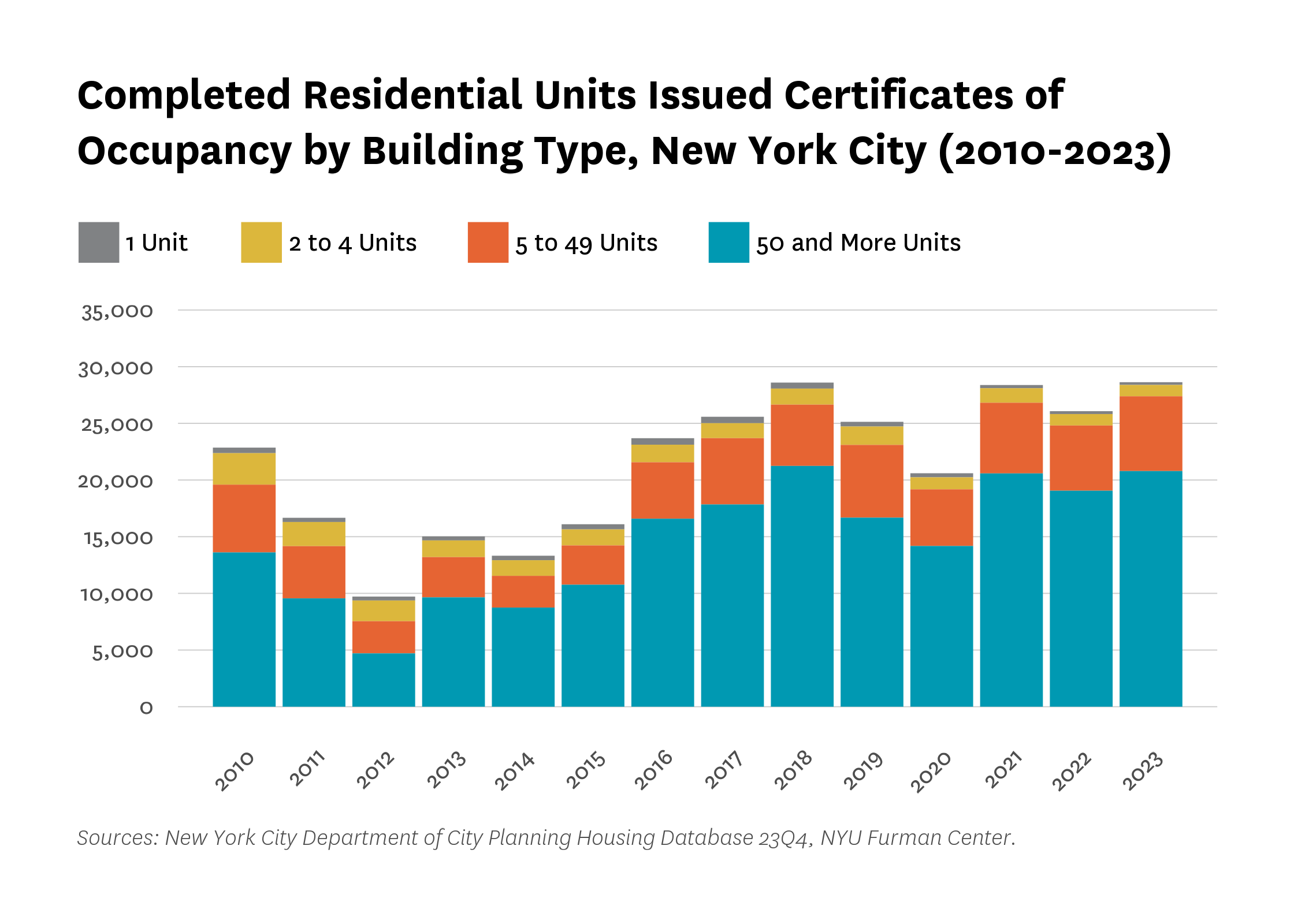
The number of units completed in 2023 increased slightly above the 2022 amount, and was the third highest in over a decade. Since 2010, the highest number of housing completions over a three year period was 2021 to 2023.
Between 2022 and 2023, the total number of new units that received a certificate of occupancy, an indicator of completion, increased by 9.8 percent to 28,631 units. The majority (72.6%) of new units authorized for occupancy in 2023 were in 50+ unit buildings, an increase of 9.1 percent from 2022, to 20,791 units. Units receiving a certificate of occupancy increased for 5-49 unit buildings (14.7% to 6,597) but decreased for single-family homes (-5.1% to 241). The number for 2-4 unit buildings hardly changed (-0.8% to 1,002 units). 2023’s total number of completed residential units was the third highest since at least 2010.