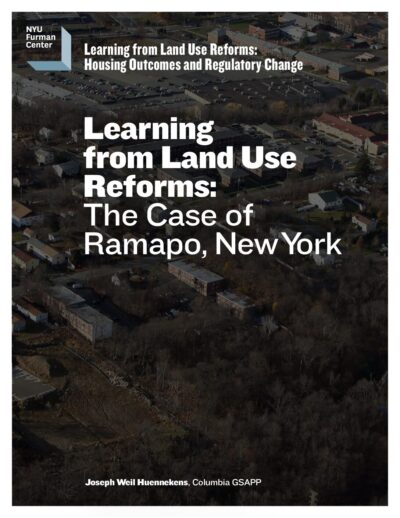
Learning from Land Use Reforms: The Case of Ramapo, New York
- Joseph Weil Huennekens
A slew of state and local governments are currently reforming zoning to increase housing production, especially of dense “missing middle” configurations. Yet not all efforts to reform single-family zoning are new. For instance, the suburban town of Ramapo, New York has continuously loosened development rules over the span of almost four decades, providing an unusually long timeline for a case study of zoning reform. This paper uses quantitative and qualitative data to assess the impact that zoning reform had in Ramapo. The case shows that the introduction of multifamily zoning—even in “built out” suburban neighborhoods—can spur the large-scale production of new housing units, while “gentle density,” like accessory zoning laws, may have more limited effects. The town’s experience also demonstrates the importance of infrastructural investment to serve new housing supply, especially when added in suburban areas. It also shows that, at least in an unusually pro-growth political environment, discretionary review and parking requirements do not automatically hinder housing production.